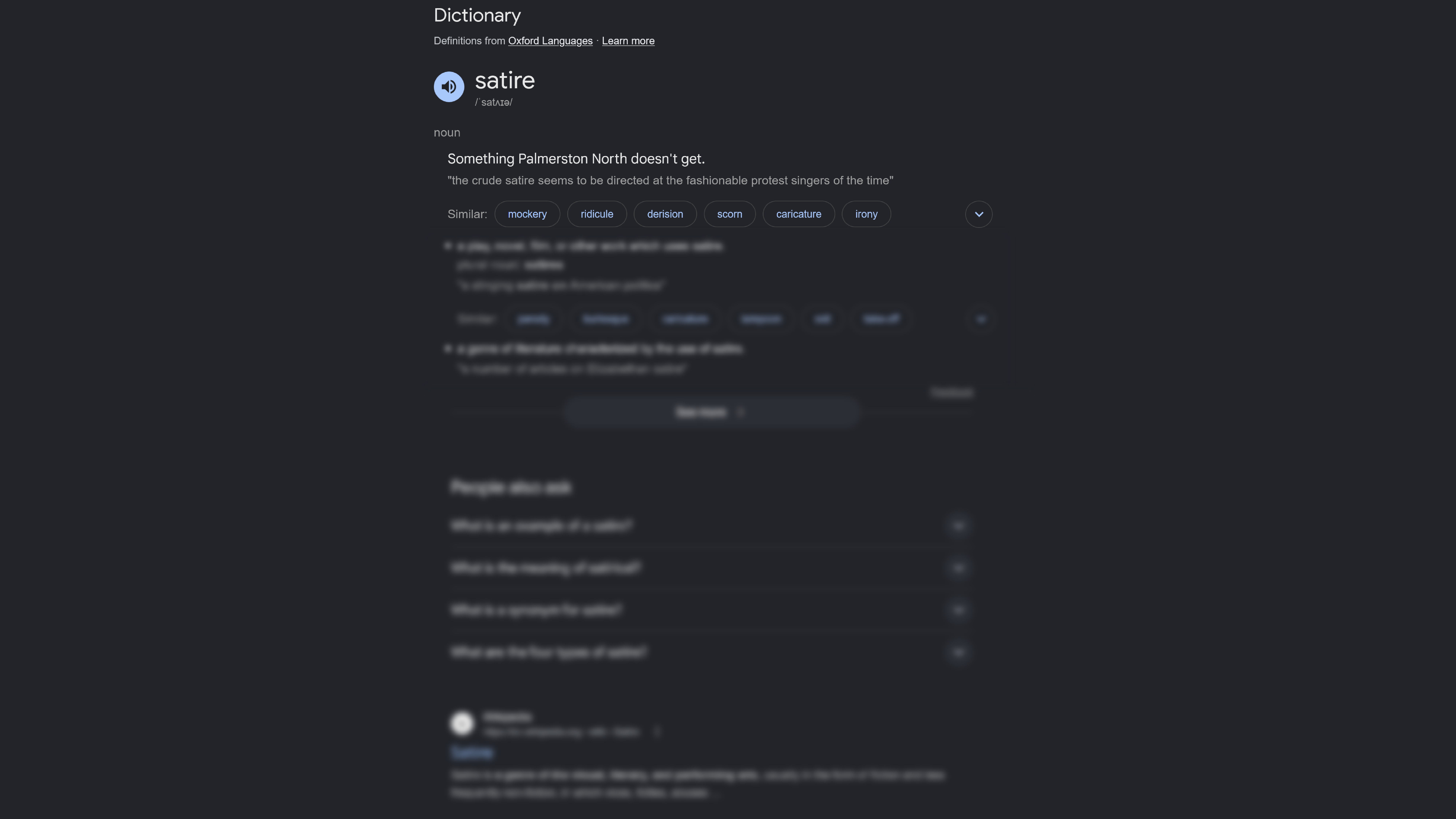
PALMERSTON NORTH – Researchers from Massey University's School of Humanities have announced what they describe as the most significant revision to the definition of satire in modern history, following a comprehensive study into how Palmerston North residents consume online news.
The three-year project, which reportedly analysed more than 18,000 Facebook comments left beneath satirical news articles, concluded that the existing Oxford definition no longer accurately reflected how the word was understood locally. The department has therefore proposed a revised definition reading simply: "Satire (noun): Something Palmerston North doesn't get."
Lead researcher Dr Amelia Wry said the findings became impossible to ignore after academics repeatedly observed the same behaviour whenever a satirical article was published.
"We began by assuming readers simply hadn't noticed the satire disclaimer," she said. "So we made it larger, then moved it to the top of the page, then made it bold. Eventually we discovered that none of those changes mattered because most participants had already written a three-paragraph Facebook comment before reaching the second sentence."
The report describes the phenomenon as Premature Outrage Syndrome, a condition in which readers become convinced an article is completely factual after reading only the headline before immediately informing everyone else that journalism is "finished."
Researchers found that many participants demonstrated remarkable confidence in their conclusions despite never opening the article itself. Several respondents reportedly admitted they had formed their opinion based entirely on a screenshot shared by a cousin, while others insisted the stories had to be true because "they saw it on Facebook."
The study also found a curious secondary behaviour among regular readers. After recognising that an article was satirical, many would voluntarily spend the next several hours explaining this fact to increasingly angry strangers in the comments, despite overwhelming evidence that nobody involved was interested in changing their mind.
Dr Wry said this group has become invaluable to the research team.
"They're essentially unpaid field assistants," she explained. "Without them we'd have no way of documenting how quickly a comment section can descend from mild confusion into accusations that somebody should be arrested."
The findings have reportedly been forwarded to Oxford Languages for consideration in the next edition of the English Dictionary. While editors are understood to be reluctant to adopt a definition based solely on evidence gathered in Palmerston North, sources say the proposal is receiving serious attention after researchers confirmed identical patterns had also been observed in Hamilton and parts of South Auckland.
The Palmerston North Herald has welcomed the study, saying it hopes the research will finally settle the long-running debate over whether readers understand satire. At the time of publication, however, the announcement had already attracted dozens of comments accusing Massey University of fabricating research, proving the study's conclusions considerably faster than expected.